Generative AI in Education: Practical Applications and the Debate Over Student Creativity
Generative Artificial Intelligence (AI) has rapidly transformed from a futuristic concept into an everyday productivity tool. Students, teachers, researchers, content creators, and professionals now use AI-powered platforms to write content, generate images, summarize information, create presentations, and even develop software.
Tools such as ChatGPT, Gemini, Claude, Midjourney, and Microsoft Copilot have made advanced AI accessible to millions of users worldwide. However, as AI adoption grows in educational environments, an important question emerges:
Does Generative AI enhance student creativity, or does it diminish independent thinking and originality?
The answer is not as simple as choosing one side. To understand the impact of AI on education, we must first explore how these tools are being used in practical, real-world scenarios.
What Is Generative AI?
Generative AI refers to artificial intelligence systems capable of creating new content based on user prompts. Unlike traditional software that follows predefined rules, generative AI can produce:
- Text and articles
- Images and artwork
- Videos and animations
- Computer code
- Presentations
- Research summaries
- Learning materials
The real value of Generative AI lies not in replacing human effort but in accelerating ideation, research, and execution.
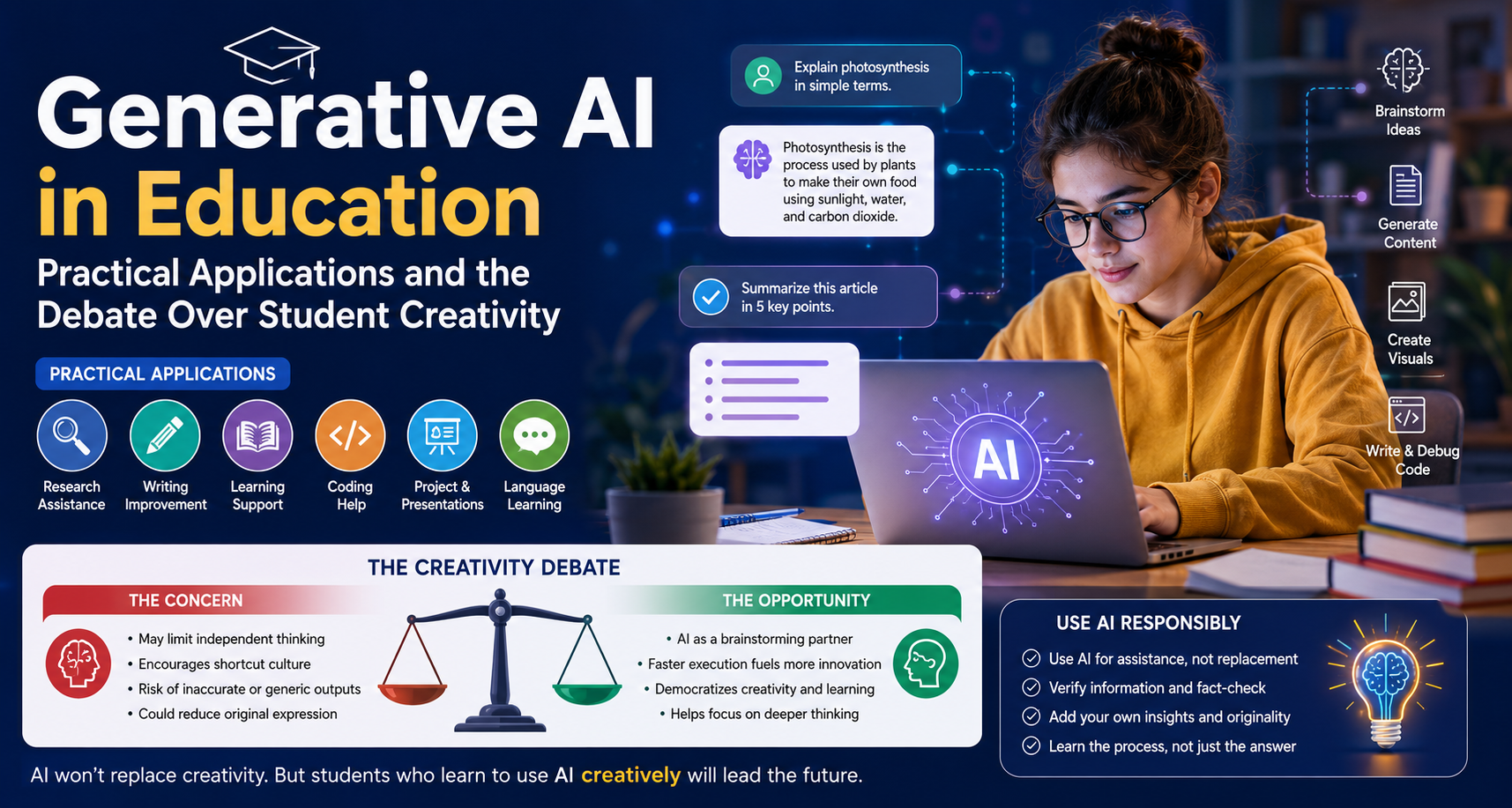
Practical Applications of Generative AI for Students
1. Research Assistance
Students often spend hours collecting information from multiple sources before beginning an assignment.
AI tools can help by:
- Summarizing lengthy articles
- Explaining complex concepts in simple language
- Creating topic outlines
- Generating research questions
- Comparing multiple viewpoints
Example:
Instead of searching dozens of websites about climate change, a student can ask:
"Explain the causes and effects of climate change in simple terms and provide key discussion points."
The AI provides a structured starting point, saving valuable time.
2. Improving Writing Skills
Many students struggle with organizing ideas and maintaining clarity in their writing.
Generative AI can assist by:
- Creating essay outlines
- Suggesting stronger vocabulary
- Correcting grammar mistakes
- Improving sentence structure
- Rewriting content for better readability
Best Practice:
Students should use AI-generated drafts as references rather than submitting them directly. The strongest outcomes occur when students refine and personalize AI suggestions.
3. Learning Difficult Subjects
Complex subjects such as mathematics, physics, chemistry, and programming can become easier with AI tutoring.
Students can ask:
- Step-by-step problem-solving methods
- Alternative explanations
- Real-world examples
- Practice questions
- Concept clarification
Unlike traditional resources, AI offers immediate and personalized assistance.
4. Coding and Software Development
Programming students increasingly use AI coding assistants.
Generative AI can:
- Generate sample code
- Explain programming concepts
- Debug errors
- Suggest optimization techniques
- Convert code between languages
For example, a beginner learning Python can request explanations for loops, functions, or object-oriented programming concepts and receive customized guidance.
5. Presentation and Project Creation
AI tools help students prepare professional presentations by:
- Generating slide content
- Creating diagrams
- Designing visual assets
- Suggesting project structures
- Summarizing key findings
This allows students to focus more on understanding concepts and presenting ideas effectively.
6. Language Learning
Students learning new languages can use AI to:
- Practice conversations
- Improve grammar
- Translate content
- Learn vocabulary
- Receive pronunciation guidance
AI provides a personalized language-learning companion available at any time.
Practical Applications for Teachers and Educators
Generative AI is not only transforming student learning but also helping educators become more productive.
Teachers can use AI to:
- Create lesson plans
- Generate quizzes and assignments
- Design classroom activities
- Develop assessment rubrics
- Personalize learning content
By reducing administrative workloads, educators gain more time for meaningful student interaction.
The Creativity Debate: Is AI Helping or Hurting Students?
The growing popularity of Generative AI has sparked intense discussion among educators, parents, and policymakers.
The Concern: AI May Reduce Creativity
Critics argue that excessive AI reliance may:
1. Limit Independent Thinking
When students immediately turn to AI for answers, they may spend less time analyzing problems independently.
Critical thinking skills could weaken if learners become passive consumers rather than active problem-solvers.
2. Encourage Shortcut Culture
Some students use AI-generated content without understanding the material.
This creates a risk where assignments are completed efficiently but learning outcomes suffer.
3. Reduce Original Expression
Creative writing, art projects, and design assignments may become less authentic if students rely heavily on AI-generated outputs.
The concern is that unique human perspectives may gradually be replaced by machine-generated patterns.
The Counterargument: AI Can Enhance Creativity
Supporters of AI believe the technology can actually strengthen creativity when used responsibly.
1. AI as a Brainstorming Partner
Creativity often begins with generating ideas.
AI helps students:
- Explore different perspectives
- Overcome creative blocks
- Discover new approaches
- Expand brainstorming sessions
Rather than replacing creativity, AI can stimulate it.
2. Faster Execution Enables More Innovation
Students spend less time on repetitive tasks and more time refining ideas.
Instead of spending hours creating a rough draft, students can focus on:
- Critical analysis
- Creative storytelling
- Visual design
- Strategic thinking
3. Democratizing Creativity
Not every student excels in writing, art, or coding.
AI helps bridge skill gaps, allowing more learners to express their ideas effectively.
This can increase participation and confidence among students who previously struggled with certain creative tasks.
Finding the Right Balance
The real question is not whether students should use AI.
The more important question is:
How should students use AI responsibly?
Educational institutions can encourage healthy AI adoption through guidelines such as:
Use AI for Assistance, Not Replacement
Students should treat AI as a tutor, mentor, or collaborator rather than a substitute for learning.
Verify AI Outputs
AI systems can occasionally produce inaccurate or misleading information.
Students must verify facts using reliable sources.
Add Personal Insights
Assignments should include original analysis, opinions, experiences, and conclusions.
Human thinking should remain at the center of the learning process.
Learn the Process
AI-generated answers are most valuable when students understand how the solution was reached.
The learning journey remains more important than the final output.
The Future of AI in Education
Generative AI will continue becoming more integrated into classrooms, online learning platforms, and educational software.
Future AI systems may offer:
- Personalized learning paths
- Real-time tutoring
- Adaptive assessments
- Intelligent study recommendations
- Enhanced accessibility for diverse learners
As these capabilities evolve, educators will need to redefine traditional approaches to teaching, assessment, and creativity.
Conclusion
Generative AI is neither the end of creativity nor a perfect solution for education. It is a powerful tool that can significantly improve learning, productivity, and innovation when used thoughtfully.
Students who learn to collaborate with AI rather than depend on it will likely gain a competitive advantage in the future workforce. The most successful learners will not be those who simply use AI, but those who combine AI-generated insights with critical thinking, originality, and human creativity.
Ultimately, Generative AI should be viewed not as a replacement for human imagination but as a catalyst that helps unlock new possibilities for learning, exploration, and creative expression.